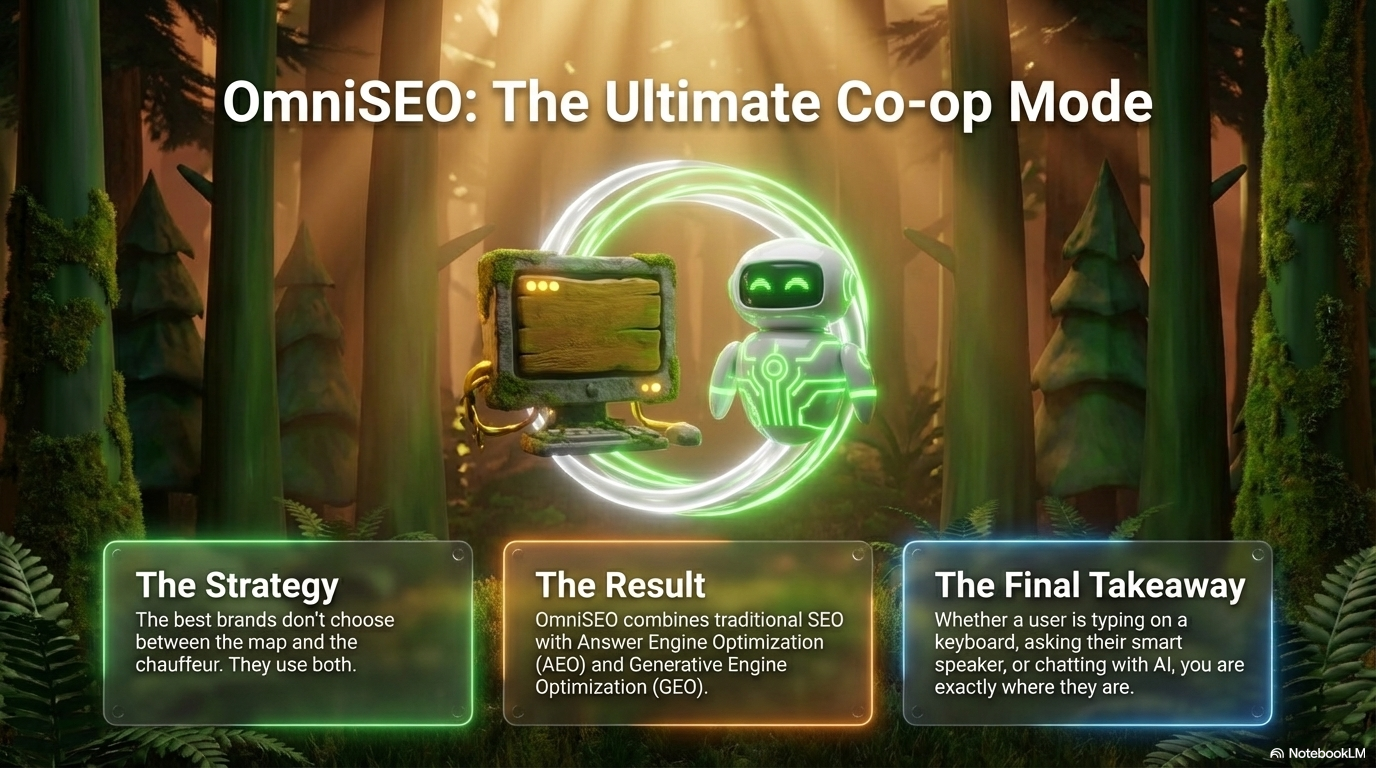
The internet has changed. The way people find information is splitting into two paths — and the smartest businesses are walking both of them.
In this free course, you'll learn the difference between SEO (Search Engine Optimization) and AEO (Answer Engine Optimization) — explained in plain English with zero jargon.
By the end, you'll understand exactly what your business needs to do to show up whether someone is typing into Google, asking Siri, or chatting with ChatGPT.
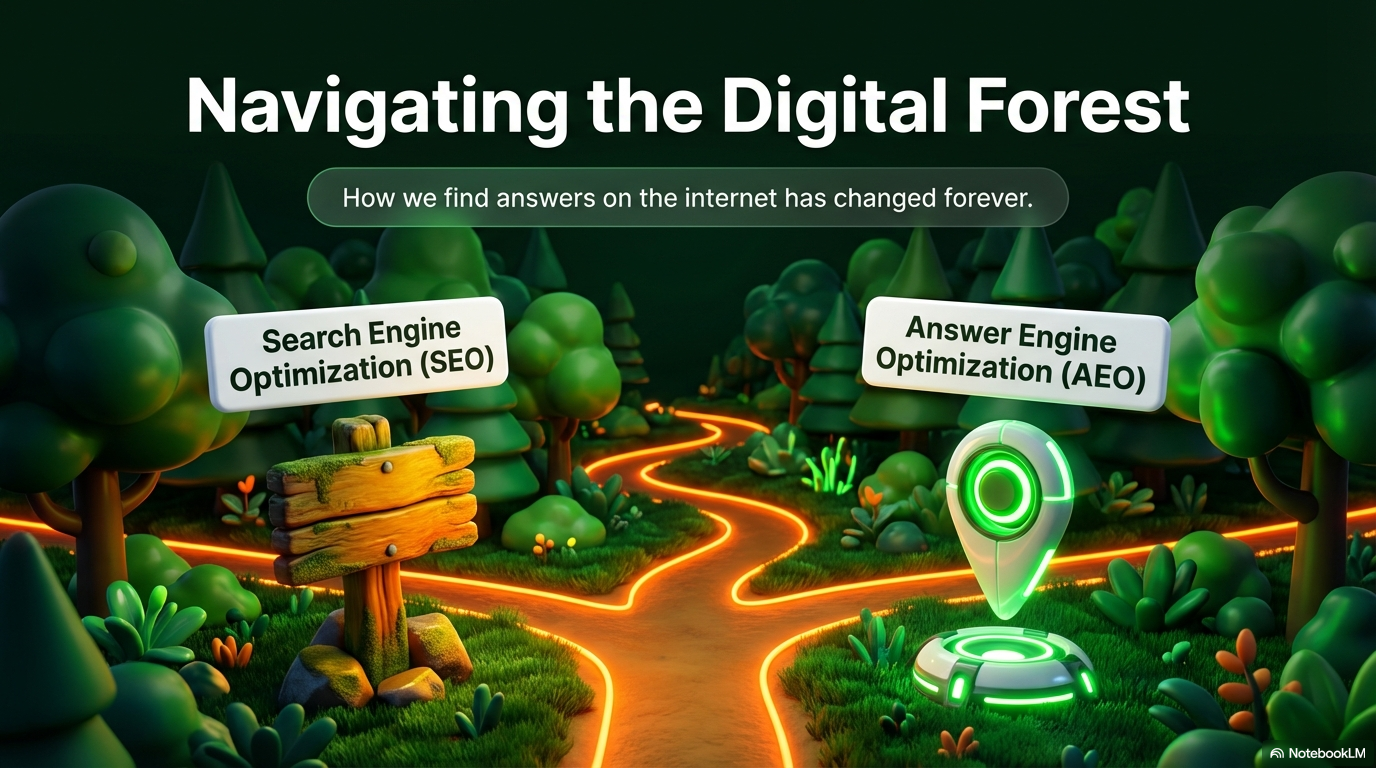
Think of the internet as a massive forest. For 30 years, there was one trail through it — search engines like Google. You typed keywords, got a list of blue links, and clicked through them until you found your answer.
That was SEO territory. Businesses fought to be the first link you'd click.
But now there's a second path. AI assistants — ChatGPT, Google's AI Overview, Alexa, Siri — don't give you a list. They give you the answer directly. That's AEO territory.
The question isn't which path is better. It's: is your business visible on both?
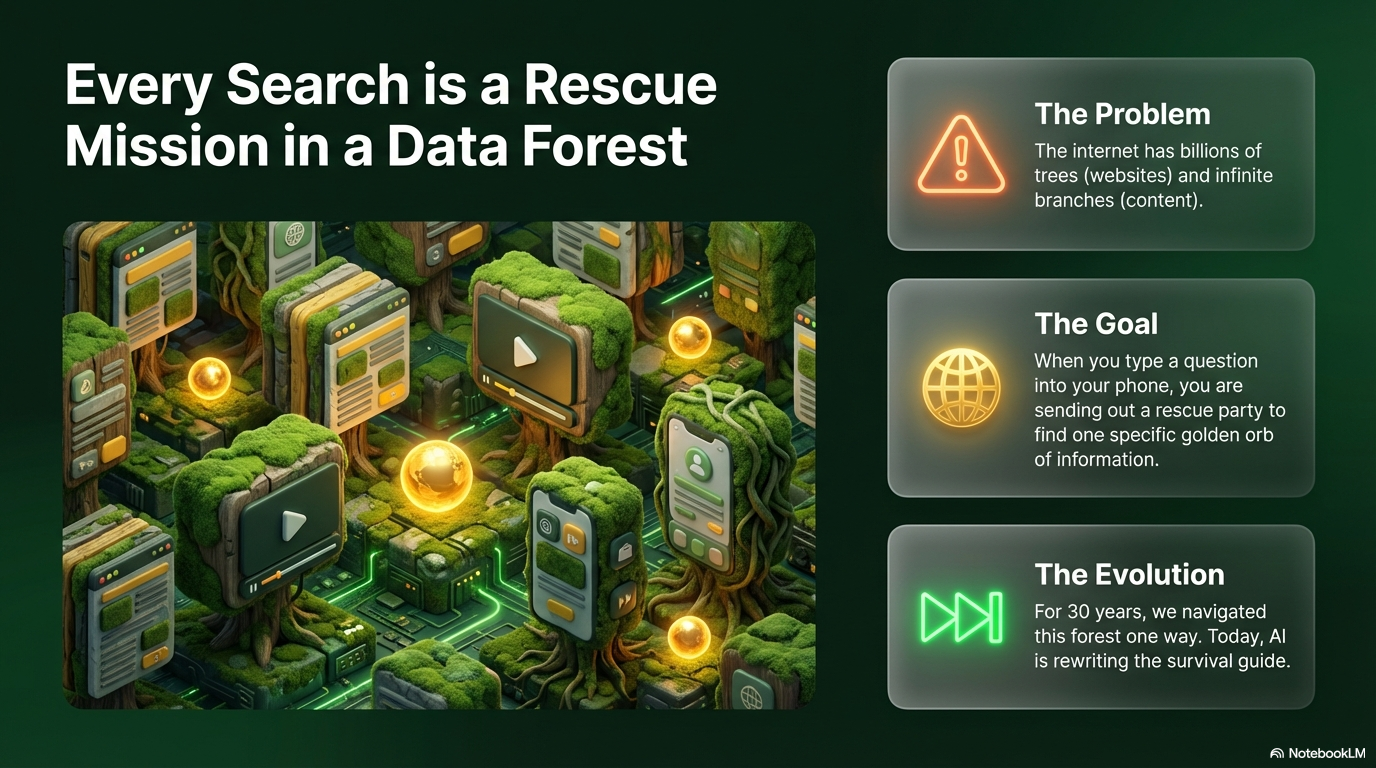
The internet has billions of websites and infinite branches of content. When you type a question into your phone, you're sending out a rescue party to find one specific piece of information.
For 30 years, we navigated this forest one way: type keywords → scan results → click links → read pages → hope you find the answer.
Today, AI is rewriting the survival guide. Instead of handing you a map and saying "good luck," it reads every page for you and hands you the answer.
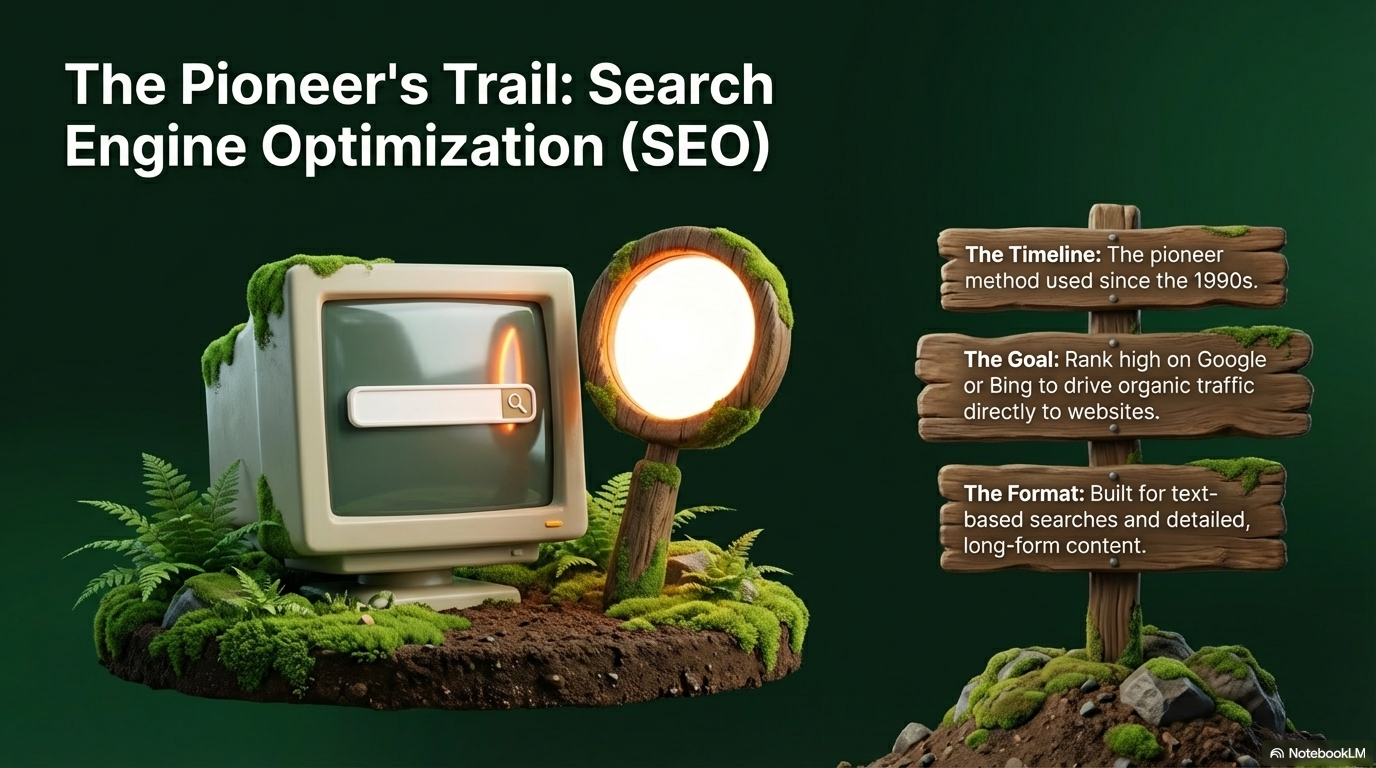
SEO has been around since the 1990s. It's the pioneer method — the original way to get found online.
The goal: Rank high on Google or Bing so people click through to your website.
The format: Built for text-based searches and detailed, long-form content. Think blog posts, service pages, product descriptions — all packed with the right keywords so search engines can match them to what people are looking for.
SEO is about driving traffic — getting people from the search results page onto your website.
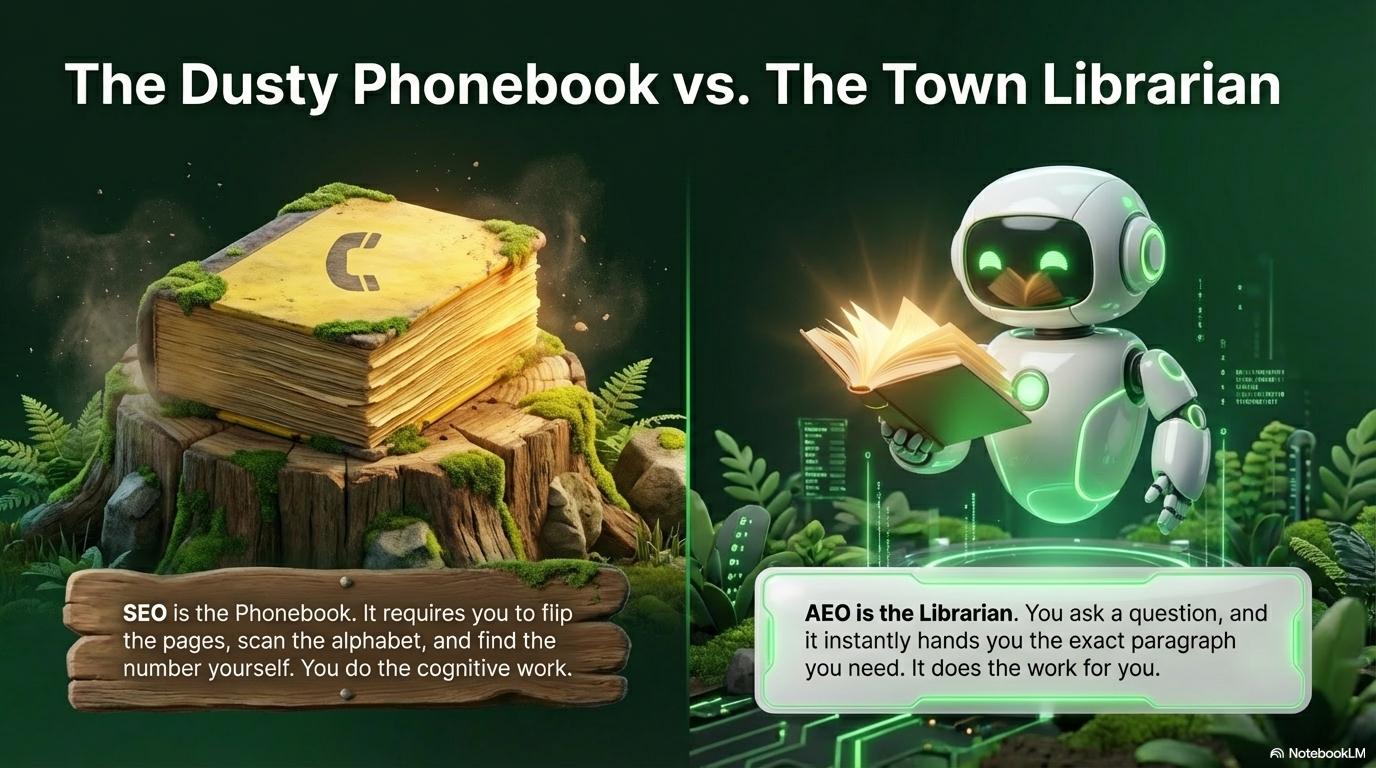
Here's the simplest way to understand the difference:
SEO is the phonebook. It gives you a list of results. You flip through the pages, scan the alphabet, and find the number yourself. You do the cognitive work.
AEO is the librarian. You ask a question, and she instantly hands you the exact paragraph you need. She does the work for you.
Both are useful. But more and more people are skipping the phonebook and going straight to the librarian.
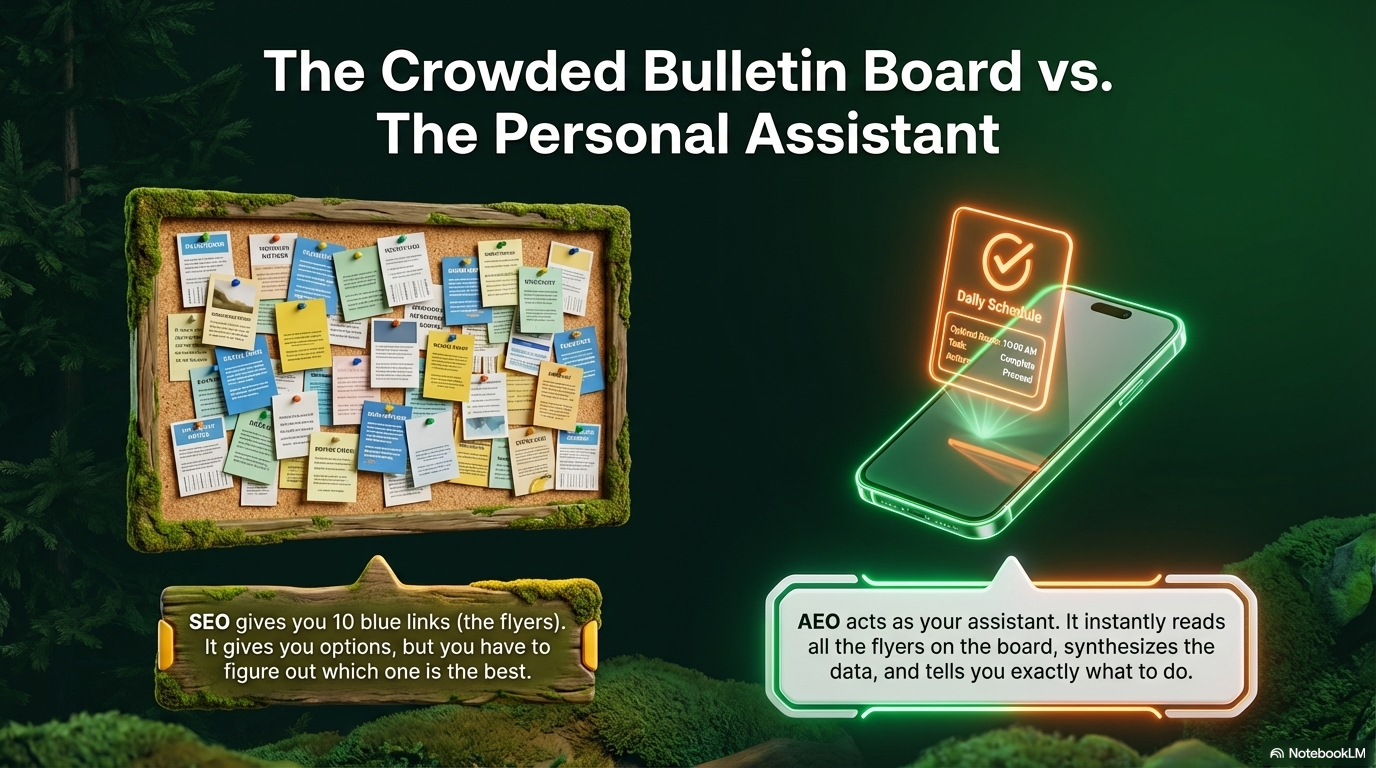
SEO gives you 10 blue links — like flyers pinned to a crowded bulletin board. You get options, but you have to figure out which one is the best.
AEO acts as your assistant. It instantly reads all the flyers on the board, synthesizes the data, and tells you exactly what to do.
This is why over 65% of Google searches now end without a click. People are getting their answer right on the search page — from AI Overviews, Featured Snippets, and Knowledge Panels.
If your business only shows up when someone clicks... you might be invisible to most searchers.
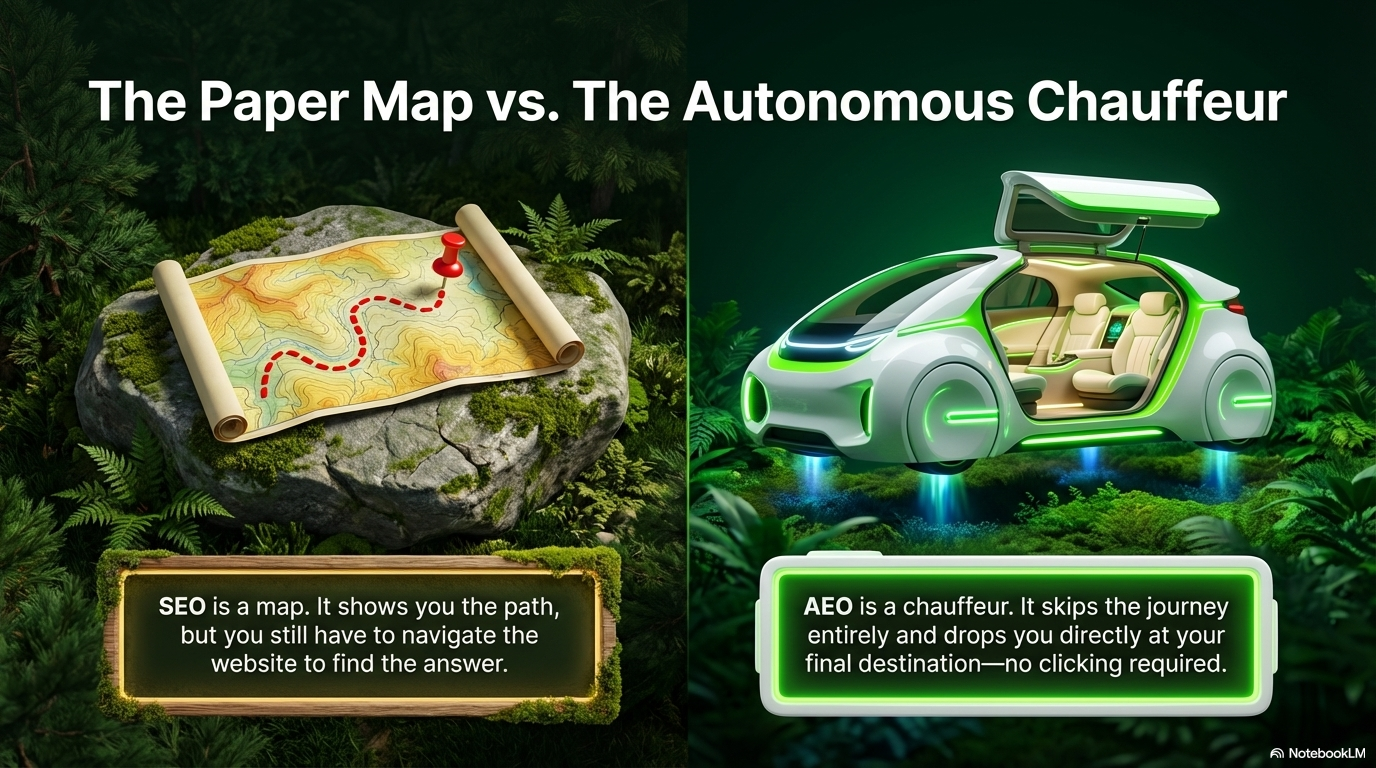
SEO is a map. It shows you the path, but you still have to navigate the website to find the answer.
AEO is a chauffeur. It skips the journey entirely and drops you directly at your final destination — no clicking required.
This is the fundamental shift happening in search right now. The question for your business isn't "should I do SEO or AEO?" — it's "am I optimized for both?"
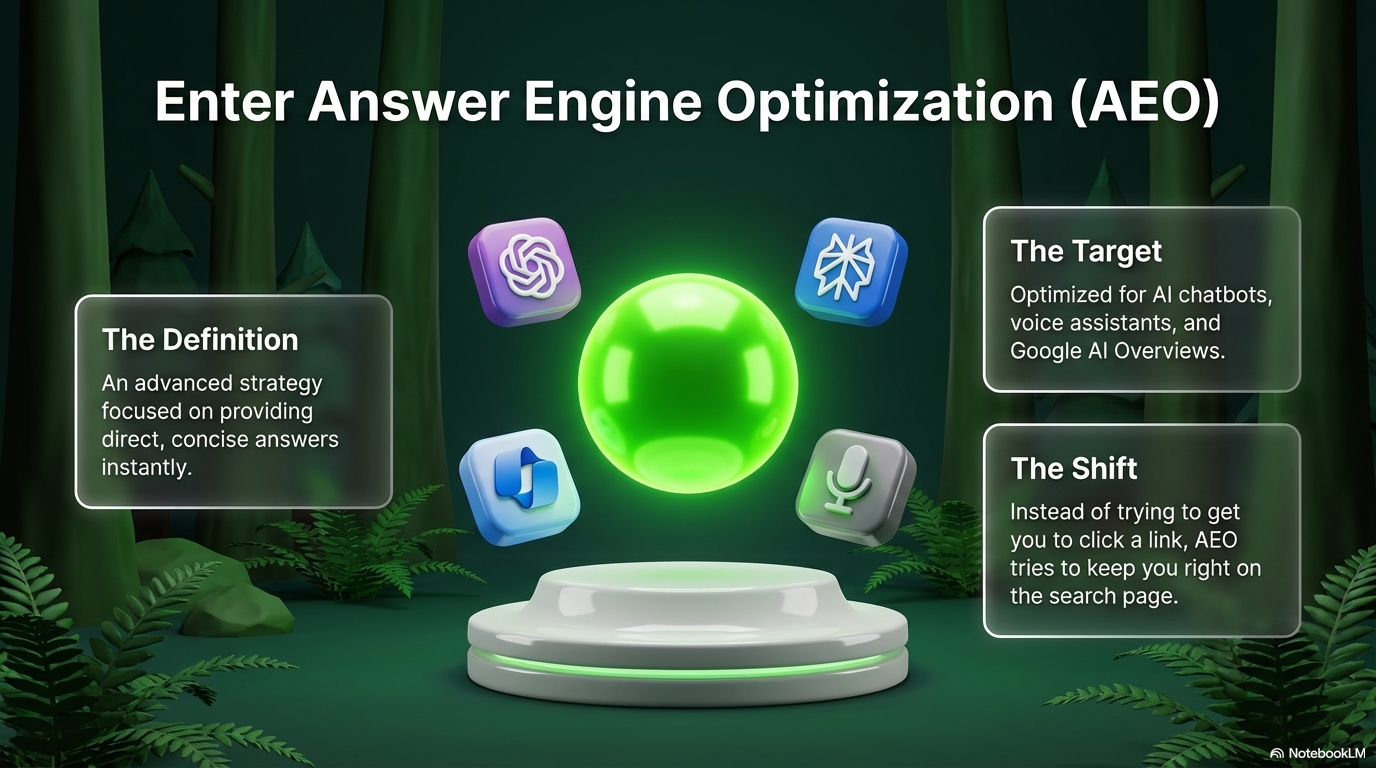
AEO is an advanced strategy focused on providing direct, concise answers instantly.
The target: AI chatbots, voice assistants (Alexa, Siri), and Google AI Overviews. These are the "answer engines" — they don't link to websites, they cite them.
The shift: Instead of trying to get you to click a link, AEO tries to keep you right on the search page — with your business's information front and center.
Think of it this way: SEO gets you in the race. AEO gets you quoted by the referee.
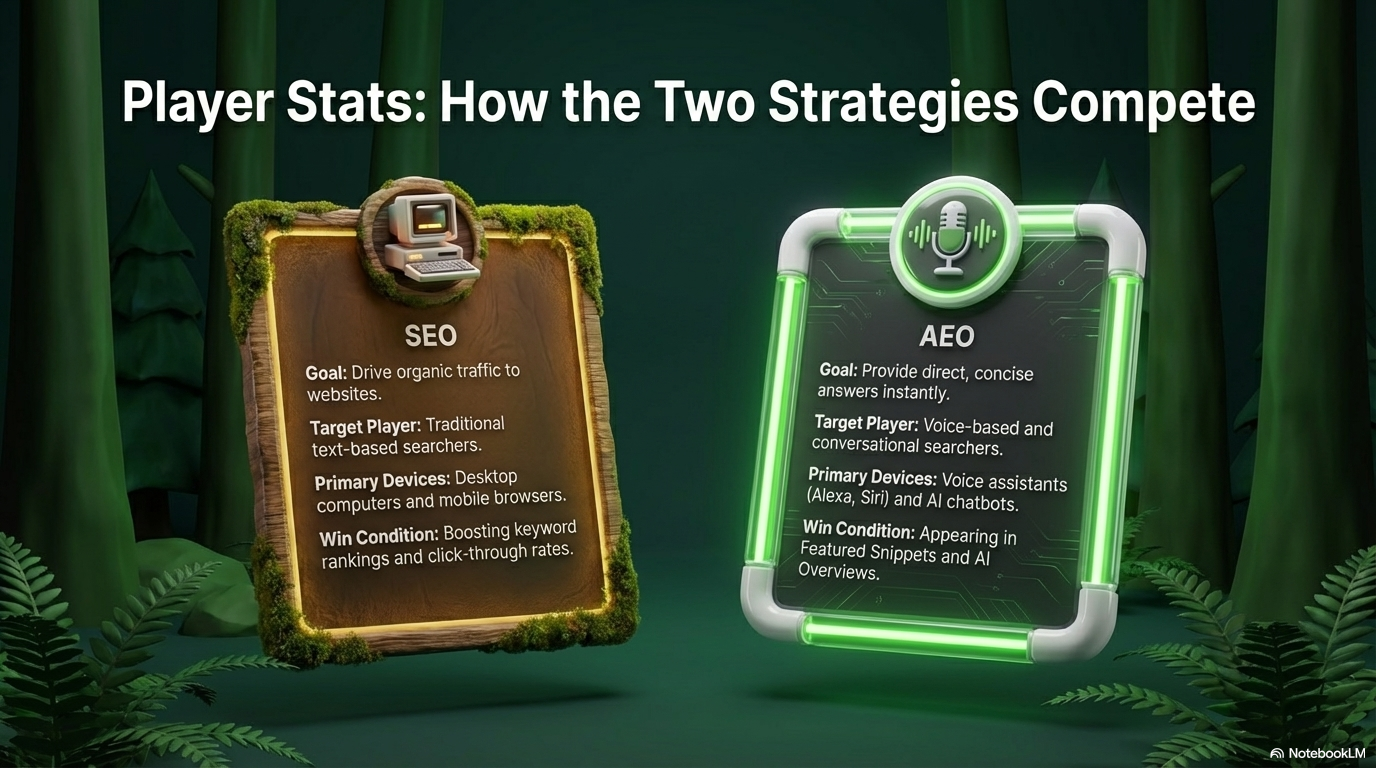
Let's break it down side by side:
SEO's goal: Drive organic traffic to websites. Target: traditional text-based searchers. Primary devices: desktop and mobile browsers. Win condition: higher keyword rankings and click-through rates.
AEO's goal: Provide direct, concise answers instantly. Target: voice-based and conversational searchers. Primary devices: voice assistants and AI chatbots. Win condition: appearing in Featured Snippets and AI Overviews.
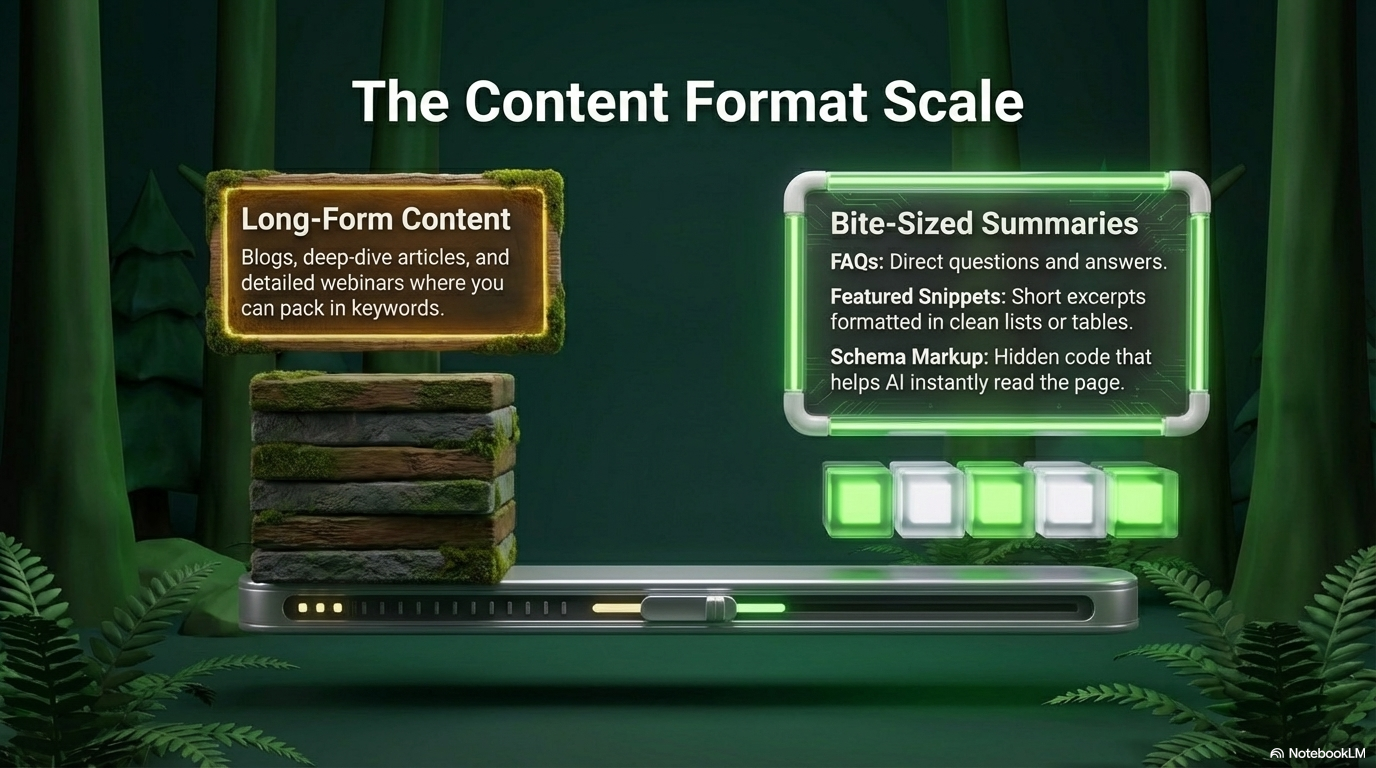
The type of content you create determines which strategy it serves:
Long-form content — blogs, deep-dive articles, detailed webinars where you can pack in keywords. This is classic SEO fuel. Google loves thorough, authoritative content.
Bite-sized summaries — FAQs (direct questions and answers), Featured Snippets (short excerpts formatted in clean lists or tables), and Schema Markup (hidden code that helps AI instantly read the page). This is AEO fuel.
The best strategy? Write the long-form content for SEO, then add the structured summaries for AEO. Same content, dual purpose.
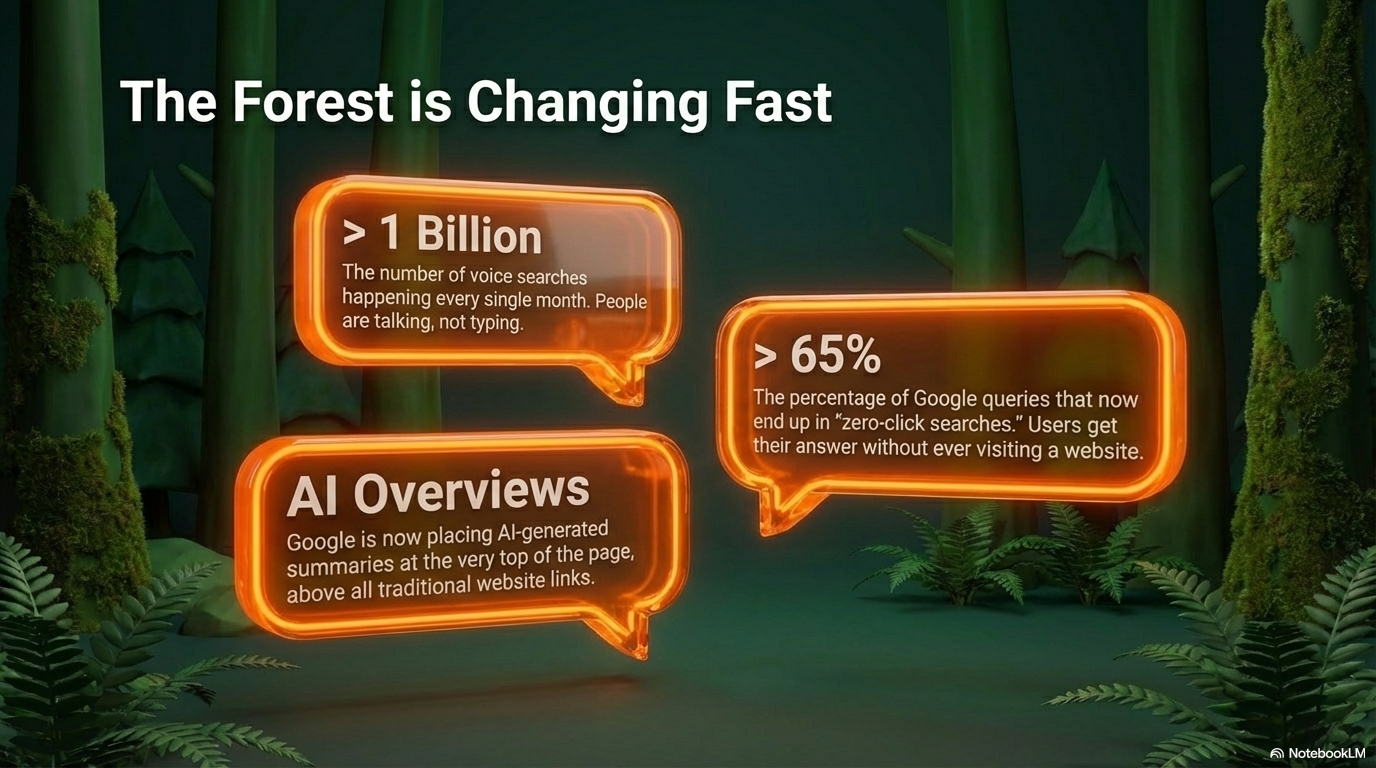
These numbers tell the story:
Over 1 billion voice searches happen every month. People are talking, not typing. And when they talk, they ask full questions — not keywords.
Over 65% of Google queries end in "zero-click searches." Users get their answer without ever visiting a website. If your business only shows up after a click... most people never see you.
Google AI Overviews are now placed at the very top of the page, above all traditional website links. AI-generated summaries are the first thing people see.
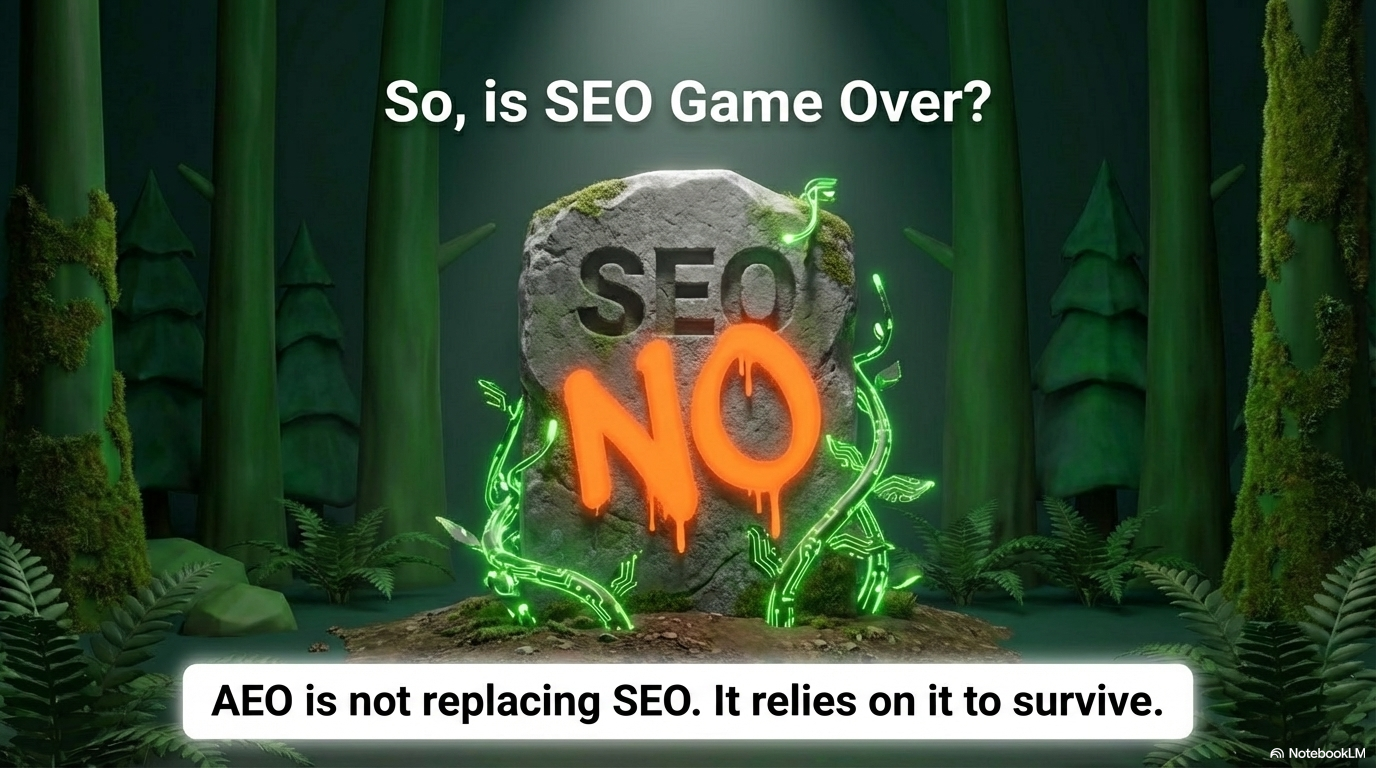
The answer is a big, bold NO.
AEO is not replacing SEO. It relies on it to survive. Think of it this way: AI assistants need content to cite. Where does that content come from? Websites that are already well-optimized for search.
Without SEO, there's no foundation for AEO to build on. Without AEO, you're invisible to the fastest-growing segment of search.
They're not competitors. They're co-op partners.
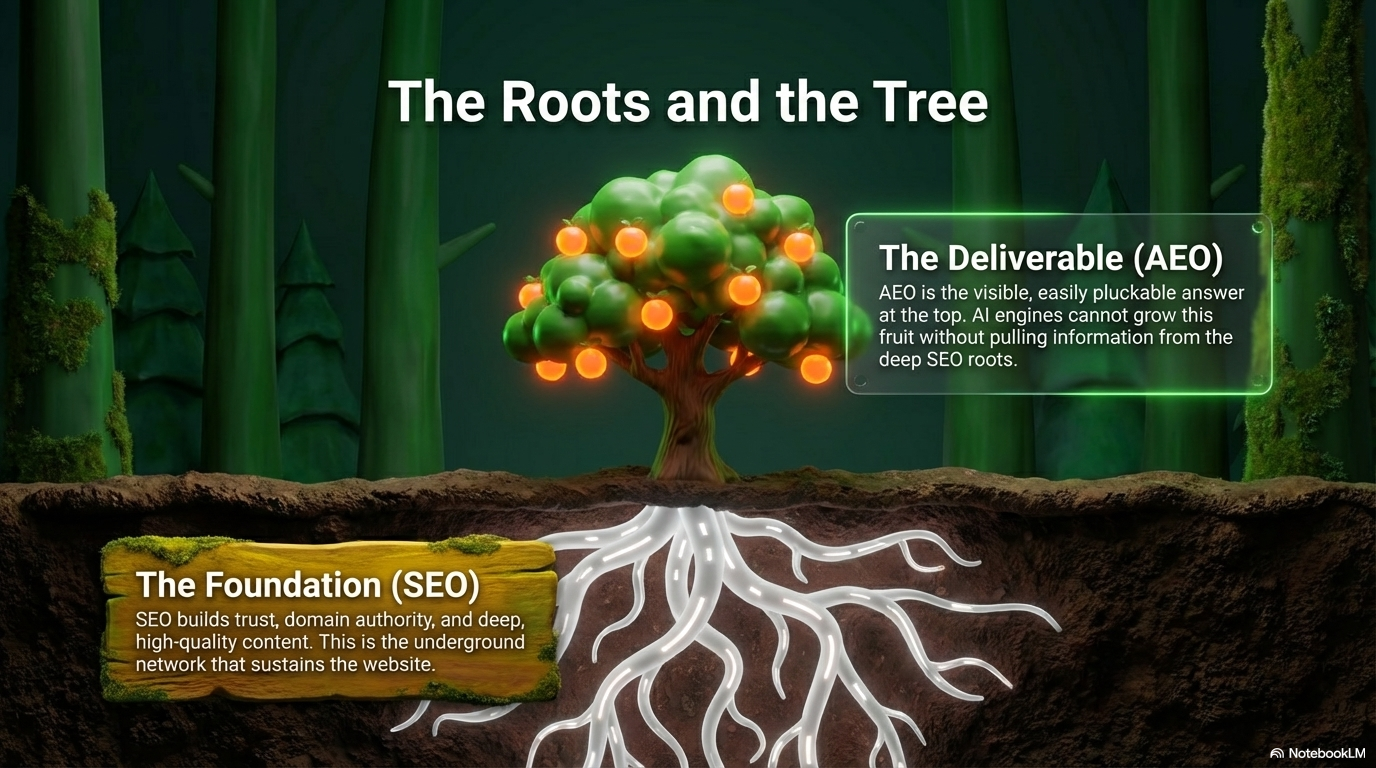
This is the image that ties it all together:
SEO is the root system. It builds trust, domain authority, and deep, high-quality content. This is the underground network that sustains the website. Without strong roots, the tree falls over.
AEO is the fruit. It's the visible, easily pluckable answer at the top. AI engines cannot grow this fruit without pulling information from the deep SEO roots.
The businesses that thrive in 2026 and beyond are the ones that build deep roots AND grow visible fruit.
How Does Your Website Score?
You've learned the difference between SEO and AEO. Now find out where your business stands with an automated AEO Visibility Scan.